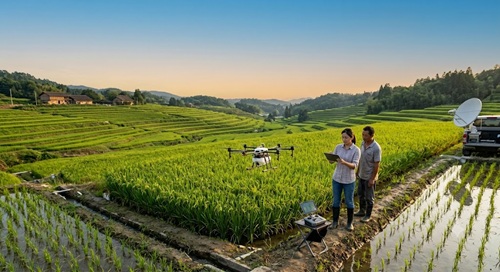
Researchers are raising concerns over a bacterial disease called Bacterial Panicle Blight (BPB), which increasingly affects rice crops in various regions. The primary culprit, Burkholderia glumae, has been identified as more aggressive and widespread than related species such as B. gladioli and B. plantarii.
B. glumae poses a serious threat to rice production, with the ability to infect plants at all stages of growth. The bacteria can cause seed rot and stunt seedling growth in early development. As plants mature, the disease advances, leading to leaf lesions and, most critically, damage to reproductive tissues. Infected panicles—rice's grain-bearing parts—often fail to fill and remain upright, resulting in significant yield losses. Agricultural experts warn that without proper management, outbreaks of BPB could significantly impact food security and economic stability in rice-producing regions.
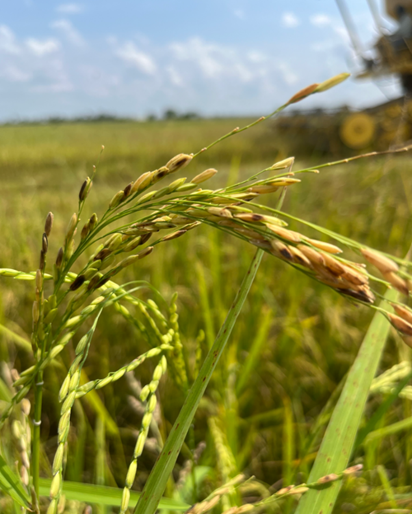
Figure 1. Symptoms of Bacterial Panicle Blight caused by Burkholderia glumae: Infected panicles exhibiting spikelet discoloration and unfilled grains.
As climate change intensifies, researchers are sounding the alarm about a deadly rice disease that thrives in heat and humidity—conditions becoming more common across rice-growing regions. Bacterial Panicle Blight (BPB), caused by Burkholderia glumae, has triggered significant crop losses in several countries, particularly during years marked by record-high temperatures. BPB is especially dangerous because it can strike at the most critical phase of rice development: flowering. Scientists have linked major BPB outbreaks to unusually warm and humid seasons, especially those with elevated nighttime temperatures
The pathogen’s adaptability is also alarming. B. glumae can survive and multiply in temperatures exceeding 40°C, making it well-suited for the heatwaves of tomorrow. As global temperatures rise, experts believe BPB will become a more frequent and severe problem, posing a serious threat to food security and rice-dependent economies. Despite these concerns, there remains a surprising gap in scientific knowledge. To date, no systematic studies have been conducted to directly examine the impact of rising temperatures on the disease’s behavior and spread. With climate patterns changing rapidly, researchers stress the urgent need for targeted studies—and solutions.
As bacterial panicle blight (BPB) threatens rice production worldwide, scientists and farmers turn to cultural practices and advanced diagnostics to manage its spread. Caused by the heat-loving bacterium Burkholderia glumae, BPB has no known chemical cure, making prevention and early detection the frontline defenses against the disease.
One key strategy involves adjusting planting schedules. Research has shown that planting rice early—before high temperatures and humidity peak—can help reduce the chances of infection. Additionally, careful management of nitrogen fertilizer has been found to lower disease risk, as excessive nitrogen can make crops more vulnerable (Wamishe et al., 2015).
However, the most effective cultural practice remains using pathogen-free seeds. Ensuring seed lots are free of B. glumae requires highly sensitive testing.
For decades, oxolinic acid—a quinolone antibiotic—stood as the only known chemical treatment against BPB, used both as a seed treatment and a foliar spray. But the miracle was short-lived. Burkholderia glumae, the heat-loving bacterium behind BPB, has evolved. Mutations in a crucial bacterial enzyme, DNA gyrase (specifically the GyrA subunit), have rendered many strains resistant to oxolinic acid, stripping farmers of the only chemical shield they had left (Maeda et al., 2004, 2007). As resistance spread, the antibiotic became ineffective. Although these breakthroughs have shown promise in the lab, whether such treatments can hold up in real-world field conditions remains unclear. The race is on to find an effective, scalable way to halt B. glumae—before rising temperatures and growing resistance allow this stealthy pathogen to gain even more ground.
By: Associate Professor Dr. Ts. Siti Izera Ismail
References
Maeda, Y., Kiba, A., Ohnishi, K., and Hikichi, Y. 2004. Implications of amino acid substitutions in GyrA at position 83 regarding oxolinic acid resistance in field isolates of Burkholderia glumae, a causal agent of bacterial seedling rot and grain rot of rice. Appl. Environ. Microbiol. 70:5613-5620.
Maeda, Y., Kiba, A., Ohnishi, K., and Hikichi, Y. 2007. Amino acid substitutions in GyrA of Burkholderia glumae are implicated in not only oxolinic acid resistance but also fitness on rice plants. Appl. Environ. Microbiol. 73:1114-1119.
Date of Input: 30/04/2025 | Updated: 26/05/2025 | noorbaiti
MEDIA SHARING