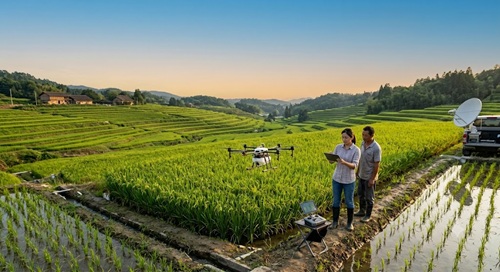
The current delay in paddy cultivation is not merely a disruption to the agricultural calendar; it represents a broader challenge affecting the availability, stability, and sustainability of Malaysia’s food system. The National Food Security Policy Action Plan (DSMN) recognizes climate change, natural disasters, water resource management, and the resilience of domestic production as critical determinants of the nation’s food security.
In line with this, the National Agrofood Policy 2.0 (NAP 2.0) identifies the paddy and rice subsector as a strategic component of national food security. Its primary objective is to increase the country’s Self-Sufficiency Level (SSL) through the development of a more resilient and technology-driven food system.
1. Impact and Risks of Delayed Planting on National Rice Supply
The risk to Malaysia’s rice supply will increase significantly if planting delays continue into June and July. This concern is justified as Kedah—particularly the Muda Agricultural Development Authority (MADA) area—is the nation’s primary rice-producing region, contributing substantially to domestic rice production. Reports indicating that only about 10% of the 56,000 farmers have been able to begin planting according to schedule suggest the early signs of a systemic disruption to the supply chain.
Technically, paddy crops require approximately 100 to 120 days to mature. If the original planting schedule in April is postponed until June or July, the entire harvesting cycle will be shifted. This delay may lead to several serious consequences:
- Overlap with the Monsoon Season: Harvesting may coincide with the monsoon transition period or heavy rainfall season.
- Increased Flood Risk: Mature crops may be exposed to flooding, threatening both yield and grain quality.
- Reduced Productivity: Adverse weather conditions can disrupt plant development and lower average yields per hectare.
- Disruption of Subsequent Planting Cycles: Delays in one season may adversely affect planting schedules for the next season.
While a one-month delay may still be manageable through improved water management and schedule adjustments, delays extending to two or three months could evolve into a systemic crisis capable of significantly reducing national rice production.
As Malaysia has yet to achieve full self-sufficiency in rice and continues to depend on imports, any loss of domestic production amid uncertainties in the global rice market could expose the country to food inflation risks. Prolonged delays may also result in:
- Increased rice import volumes;
- Higher retail rice prices;
- Greater government expenditure on subsidies, and
- Uncertainty in managing national buffer stock reserves.
To address such disruptions, the DSMN emphasizes strategies such as diversifying domestic food sources, strengthening food reserves, and maintaining a high level of crisis preparedness.
2. Vulnerability of Malaysia’s Food Security System to Climate Shocks
Malaysia’s paddy production system remains highly vulnerable to climate shocks such as the El Niño phenomenon. This vulnerability stems from the sector’s dependence on natural rainfall patterns, existing irrigation infrastructure, and traditional seasonal planting schedules.
The effects of El Niño can be observed through three main factors:
A. Water Resource Disruptions
El Niño significantly reduces rainfall, affecting reservoir levels and the efficiency of irrigation schemes. Farmers often face a difficult dilemma: planting early may result in water shortages, while delaying planting increases the risk of flooding later in the season. This situation highlights the fragility of Malaysia’s agricultural system and its sensitivity to climate anomalies.
B. Small-Scale Production Structure
NAP 2.0 confirms that the majority of Malaysia’s food producers are small-scale farmers with limited capital and technological capacity. Consequently, they are among the most vulnerable groups when climate-related shocks occur due to:
- Limited financial capacity to absorb post-disaster losses;
- Lack of access to accurate weather forecasting technologies;
- Difficulty in developing or accessing alternative irrigation systems; and
- Low adaptive capacity to environmental changes.
C. Low Rate of Technology Adoption
NAP 2.0 also highlights that the adoption of modern technologies within the agricultural sector remains insufficient and requires urgent improvement. To strengthen long-term resilience, comprehensive structural reforms are needed, including:
- Data-Driven Smart Agriculture: Utilizing water sensors, Internet of Things (IoT) technologies, and Artificial Intelligence (AI) for microclimate forecasting and dynamic planting schedules.
- Climate-Resilient Paddy Varieties: Accelerating research and adoption of drought-tolerant and flood-resistant rice varieties.
- Upgrading Irrigation Infrastructure: Developing modular water storage facilities, flexible irrigation systems, and water recycling facilities in granary areas.
- Real-Time Climate-Agriculture Data Centers: Establishing transparent and rapid early warning systems that provide farmers with timely information.
These mitigation measures align with the DSMN’s objective of making climate adaptation technologies a key pillar of national strategy.
3. Impact of Rising Operating Costs on Farmers’ Motivation, Long-Term SSL, and Policy Interventions
An increase in operating costs exceeding 50% signals that the challenges facing the sector are no longer short-term operational issues but rather concerns about the economic viability of paddy farming. If farmers’ profit margins continue to shrink, several long-term consequences may arise:
- Decline in Active Farmers: Younger generations may avoid the paddy sector due to its diminishing competitiveness compared to other industries.
- Reduction in Active Paddy Land: Farmers may choose to lease out their land, convert it for industrial or residential use, or leave it idle.
- Declining Self-Sufficiency Level (SSL): Reduced domestic production will increase reliance on imports, exposing Malaysia to geopolitical risks and export restrictions imposed by supplier countries.
One-off financial assistance, such as the RM200 per hectare incentive under the Paddy Production Incentive Programme (IPKP), addresses only the symptoms rather than the structural causes of the problem.
To ensure the long-term sustainability of the sector, several strategic policy interventions should be implemented:
- Smart Subsidies Based on Actual Costs
Rationalize subsidies through targeted support for critical inputs such as fertilizers and diesel, adjusted according to market price fluctuations.
- Climate Index-Based Crop Insurance Scheme
Establish comprehensive financial protection mechanisms to compensate farmers for losses caused by droughts, floods, or significant yield reductions.
- Large-Scale Farming Models (Paddy Estates)
Encourage land consolidation to facilitate commercial-scale mechanization and achieve economies of scale.
- Agro-Technology Service Providers
Strengthen the agricultural value chain by directly connecting farmers with technology providers, thereby reducing initial capital investment costs.
- Income Diversification Opportunities
Encourage farmers to generate supplementary income through initiatives such as agrivoltaic solar projects, intercropping systems, and participation in high-value downstream activities.
Conclusion
The current seasonal planting delays should be regarded as a clear wake-up call that Malaysia’s paddy production model requires comprehensive structural reform. Without bold and transformative policy actions, the country risks a decline in rice self-sufficiency levels, ultimately threatening the long-term resilience and stability of its national food security system.
Prepared by:
Prof. Dr. Abdul Rahim Abdul Samad
Head, Agricultural and Food Policy Studies Laboratory
Institute of Tropical Agriculture and Food Security (ITAFoS)
Universiti Putra Malaysia (UPM)
Date of Input: 03/06/2026 | Updated: 03/06/2026 | ilyaaqeela
MEDIA SHARING