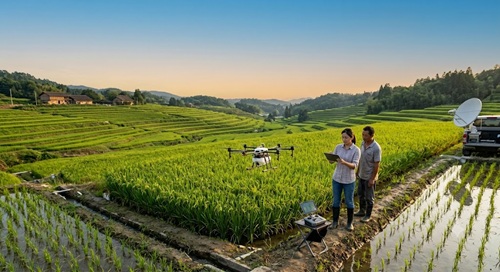
Rice (Oryza sativa L.) is the cheapest source of carbohydrate and protein in Asia and a good source of minerals and fibre. Filled grains and yield are the most affected aspects of rice under water stress. Usually, when this happens, empty grains are more numerous than filled grains, which may result in a lower yield of rice. The filling of grain is a crucial stage in rice growth, where the activities of starch-biosynthesizing enzymes actively occur and contribute to rice yields (Sekhar et al., 2015).

Grain yield is a quantitative tray which is greatly influence by different environmental and genetic factors. Rice yield is determined by several agronomic characters such as days to heading, days to maturity, filled grain period, the number of reproductive tillers, number of grain filling per panicle, length of panicle, thousand grains weight and grain weight (Badshah et al., 2014). The number of grains per panicle can be determined at the vegetative and reproductive phases, respectively. The thousand grains weight is an important trait that is normally determined during the ripening phase. A higher number of tillers can be expected in a longer vegetative phase, but the available space or optimum growth will determine the number of reproductive tillers. The tillering stage is important for determining the number of panicles (Badshah et al., 2014). Slowly filled grains can frequently be related to the delay of whole plant senescence (Mohapatra et al., 2011).

Grain filling is an ultimate stage of development in rice grains (fertilized ovaries develop into caryopses) and depends on current assimilates from photosynthesis and assimilates reallocated from storage pools in vegetative tissue (Thameur et al., 2012). Culms and sheaths provide 10-40% of the ultimate yield (Asli and Houshmandafar, 2011). Remobilization and relocation of reserve assimilate in vegetative tissue to the grain in monocarpic plants such as rice and wheat involve the initiation of whole plant senescence (Asli and Houshmandafar, 2011). Normally, water stress in a filled grain period encourages early senescence and reduces the time of filled grains but enhances the remobilization of assimilates from straw to grains (Thameur et al., 2012).

In grains, sucrose synthase, ADP glucose pyrophosphorylase (AGP), starch synthase (StS), and starch branching enzyme (SBE) are the main enzymes involved in the conversion of sucrose into starch. These enzymes are associated with the starch accumulation rate in grain (Pandey et al., 2012). In the source (stems), better activities of alpha-amylase and sucrose phosphate synthase result in the fast hydrolysis of starch and enhanced remobilization in the source (stem), whereas in the sink organs (grains), an improved grain-filling rate is attributed to increased sink activity resulting from the management of the key enzymes that are involved in the conversion of sucrose into starch (Pandey et al., 2012). The summarized all the aforementioned grain filling formation in figure display on the right.

This article was published in the book Plant, Soil and Microbes (Volume 1: Implications in Crop Science), edited by Khalid Rehman Hakeem, Mohd Sayeed Akhtar, and Siti Nor Akmar Abdullah. The chapter titled ‘Foliar Application of Polyamines to Manage Water Stress for Improved Grain Filling Formation and Yield in Rice Plants’ appears on pages 353–366.
Source of information:
Asli DE, Houshmandfar A. (2011). An anatomical study of vascular system of spikelet supplying translocates to differentially growing grains of wheat. Adv Environ Biol. 5:1597–1601.
Badshah, M.A., Tu N, Zou Y, Ibrahim M, Wang K (2014). Yield and tillering response of super hybrid rice Liangyoupeijiu to tillage and establishment methods. Crop J., 2:79-86.
Mohapatra P, Panigrahi R, Turner NC. (2011). Physiology of spikelet development on the rice panicle. Adv Agron. 110:333–359.
Pandey MK, Rani NS, Madhac MS, Sundaram RM, Varaprasad GS, Sivaranjani AKP, Bohra A, Kumar GR, Kumar A (2012). Different isiforms of starch-synthesizing enzymes controlling amylose and amylopectin content in rice (Oryza sativa L.). Biotech Adv, 30: 1697-1706.
Sekhar S, Panda BB, Mohapatra T, Das K, Shaw BP, Kariali E, Mohapatra PK. (2015). Spikelet-specific variation in ethylene pro duction and constitutive expression of ethylene receptors and signal transducers during grain filling of compact and lax- panicle rice (Oryza sativa) cultivars. J Plant Physiol, 179:21–34.
Thameur A, Belgacem L, Ali F. (2012). Drought effect on growth, gas exchange and yield, in two strains of local barley Ardhaoui, under water deficit conditions in southern Tunisia. J Environ Manag. 113:495–500.
Disclaimer:
The opinions expressed in this article are those of the writers. They do not purport to reflect the opinions or views of ITAFoS.
Date of Input: 29/12/2025 | Updated: 29/12/2025 | noorbaiti
MEDIA SHARING